Note: Consult a doctor for health advice. Check out my favorite health products here: (Amazon Affiliate commission applies)

Do Acupressure Slippers Really Work for Plantar Fasciitis?
Discover the truth about acupressure slippers as a treatment for heel pain and plantar fasciitis. Learn about their science, benefits, and how they can complement your recovery plan. Do Acupressure Slippers Really Work for Plantar Fasciitis?
YOGA AND NATUROPATHY
Rajesh Kumar
3/21/20265 min read
Do Acupressure Slippers Really Work for Plantar Fasciitis? A Critical Look
My dear friends, if you’re reading this, chances are you’re all too familiar with that sharp, stabbing pain in your heel. The one that feels like stepping on a small, pointy rock first thing in the morning. It's a common, frustrating companion: Plantar Fasciitis. This persistent condition can make every step feel like a challenge, turning simple tasks into painful hurdles. In our collective quest for relief, we’ve probably all tried different stretching routines, invested in better shoes, or even contemplated more invasive procedures. And now, you've likely seen them popping up everywhere—the promises of simple, passive relief: acupressure slippers. But do they really work? Or are they just another health fad capitalizing on our desperation? I've been looking into this a lot recently, driven by both curiosity and a desire to help others find genuine solutions. It's time to peel back the layers and see what's actually going on.
The pain from Plantar Fasciitis is rooted in inflammation of the plantar fascia, a thick band of tissue that runs across the bottom of your foot, connecting your heel bone to your toes. This tissue acts as a shock absorber and supports the arch of your foot. When it's overstrained, small tears can develop, leading to inflammation and that characteristic morning agony. The traditional path forward involves plenty of rest, proper stretching of the calves and fascia, night splints, and wearing supportive shoes even inside the house. It's a journey that requires patience and consistency.
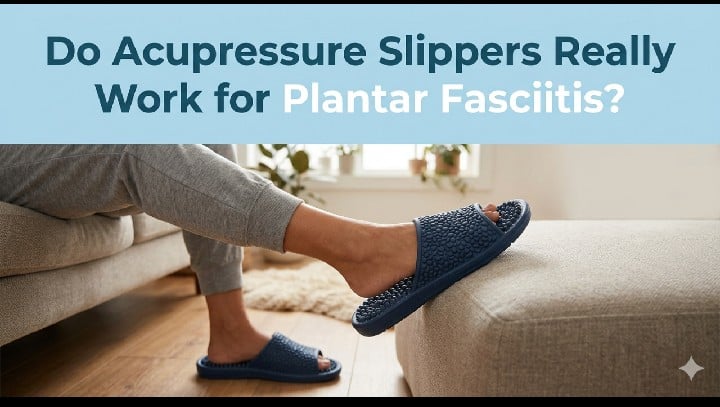
Now, let's turn our attention to the latest contender: those distinctive-looking sandals with textured soles. Let's explore this now, because understanding what acupressure slippers are is the first step. They aren't your average fluffy slippers or sleek slides. Instead of a smooth insole, they feature a landscape of small, raised nodes, nodules, or points. The idea is to stimulate specific acupressure points on the sole of your foot, a concept heavily influenced by Traditional Chinese Medicine (TCM). The theory behind them is that these small points on the foot correspond to various organs and systems throughout the body. By applying pressure to these points while you walk, the slippers are claimed to improve circulation, reduce muscle tension, and alleviate pain—both in the feet themselves and in other parts of the body.
The promised benefits for Plantar Fasciitis specifically are captivating: a passive treatment that reduces tension in the inflamed fascia, improves blood flow to aid healing, and provides natural pain relief with every step. When you’re dealing with a condition that can make standing for any length of time uncomfortable, the idea of simply walking around your house in a special pair of slippers to get better seems almost too good to be true. But is it?
As far as reality is concerned, the direct scientific evidence supporting the claim that acupressure slippers can cure Plantar Fasciitis is, unfortunately, very limited. There aren't many well-designed, randomized controlled trials that focus specifically on this question. Many people have reported some degree of pain relief, but large-scale, rigorous studies are lacking. What the broader scientific literature does support is that techniques like foot massage and general acupressure (using hands or other tools on various points) can be effective for managing pain and improving circulation in a variety of contexts. It’s reasonable to infer that the principles behind the slippers might offer some benefit. However, a crucial distinction exists between finding relief from the symptoms (like reducing immediate soreness) and actually curing the underlying inflammation and tissue damage. Thinking of them as a standalone cure, like taking a magic pill, would likely lead to disappointment.
In my experience and from what I've observed in friends and family trying them, the initial impression is often one of discomfort. The sensation of walking on those bumps can be surprisingly intense at first. You don't just slip them on and feel immediate, blissful comfort. In fact, many people have to start by wearing them for just five or ten minutes a day and gradually increase the duration as their feet become accustomed to the sensation. Some never fully get used to it and find them too unpleasant to wear regularly. Yet, for those who push past that initial phase, some do describe a feeling of reduced tightness and a temporary easing of that sharp morning pain. It often feels less like a cure and more like a gentle, constant massage that takes the edge off the overall level of discomfort throughout the day. They have mentioned that it’s another tool in their kit, alongside calf stretches and good orthotics, but not a replacement for them.
So, let's break down the potential benefits and drawbacks. On the positive side, acupressure slippers are:
Non-invasive: There are no medications, injections, or surgeries involved. It's a completely external and simple approach.
Relatively Affordable: Compared to custom orthotics or multiple physiotherapy sessions, a pair of these slippers can be a modest investment.
Easily Accessible: You can find them online and in many wellness stores without needing a prescription.
A Passive Treatment (Once broken in): You can wear them while performing daily household activities, making it an integrated part of your day rather than a separate time-consuming exercise.
However, the downsides are equally important to consider:
Lack of Direct Proof: We must come back to the point that there is no strong scientific consensus confirming their specific effectiveness for curing Plantar Fasciitis.
Initial (and sometimes persistent) Discomfort: The bumps can be painful, discouraging regular use for many.
Not a Universal Solution: What works slightly for one person might do nothing for another, making it a bit of a gamble.
Potential Delay in Proper Treatment: A significant concern is that someone might exclusively rely on these slippers, ignoring more evidence-based treatments and potentially prolonging the condition or allowing it to worsen.
If you’re thinking about giving them a try, the key is to manage your expectations. I have found that the most practical way to view acupressure slippers is as a supplementary tool, rather than a primary treatment. Think of them as part of a larger, comprehensive approach. You could consider integrating them into your day after you’ve completed your essential morning stretches and before you head out in your most supportive shoes. Without taking up any more time, let's proceed to how you might actually incorporate them. You could start by wearing them for a short walk after a long day of standing, or while doing light chores. But remember to listen to your body; if they cause significant pain, they probably aren't for you. And crucially, don't let using them take precedence over established, effective strategies.
My final thoughts on the matter are nuanced. Do acupressure slippers really work for Plantar Fasciitis? The answer is not a simple yes or no. They are unlikely to be a standalone cure. However, as a low-risk, non-invasive method for potentially managing symptoms and providing some temporary relief as part of a multi-pronged approach, they might have a place for some individuals. They are perhaps best seen as a potential "quality of life" improvement tool, offering a small assist in navigating a very painful and persistent problem.
My advice would be this: before you rush out to buy a pair, speak with your doctor, a podiatrist, or a physical therapist. They can help you develop a comprehensive treatment plan that is tailored to your specific needs, which might very well include stretches, proper footwear, and rest. If you and your healthcare provider are both comfortable with it, you could then try acupressure slippers as an added, optional measure. But always prioritize proven medical advice and remain realistic about what they can truly achieve. Ultimately, the best way to tackle Plantar Fasciitis is through a combination of patient, consistent, and evidence-based efforts. May your feet feel lighter soon.
Contact
Reach us to book your wellness session
Email - rajnaturcure@gmail.com
© 2025. All rights reserved.