Note: Consult a doctor for health advice. Check out my favorite health products here: (Amazon Affiliate commission applies)

How to Use a Trigger Point Massage Stick for Neck Tension
Struggling with a stiff neck from screen time? Discover how a trigger point massage stick can provide effective shoulder pain relief. Learn techniques to ease those painful knots and regain mobility.How to Use a Trigger Point Massage Stick for Neck Tension
MASSAGE THERAPY
Rajesh Kumar
3/29/20267 min read
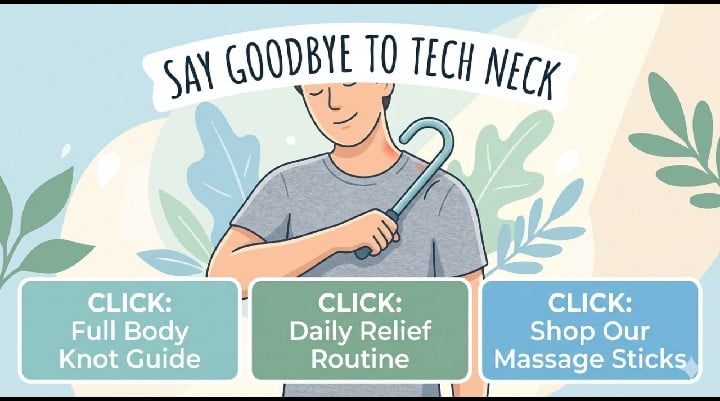
My dear friends, I think we can all agree on one thing: living with a stiff neck is absolutely miserable. You know that feeling when you try to glance over your shoulder while merging onto the highway and your neck just says "nope"? Or that dull, nagging ache that starts at the base of your skull and eventually turns into a full-blown headache by lunchtime? I’ve been there more times than I care to count.
As far as reality is concerned, most of us spend way too much time hunched over laptops or staring down at our phones. We call it "tech neck," but whatever the name, it feels like someone tied a bunch of tight knots in our muscles and then forgot how to undo them. In my experience, a regular heating pad or a quick rub with your hand just doesn't cut it when those knots really settle in. That’s why I finally decided to try out one of those weird-looking trigger point massage sticks—you know, the ones that look like a giant plastic candy cane or a shepherd’s crook.
At first, I thought it looked like a medieval torture device. But honestly? It has become my absolute favorite tool for staying loose. Without further ado, let’s proceed and talk about how you can actually use one of these things to get some real relief.
Understanding the Magic of the Hooked Massage Stick
When you first get your hands on a massage stick, it feels a bit awkward. It’s long, it has all these little knobs sticking out of it, and you might wonder if you need an engineering degree just to hold it right. But let’s explore this now: the beauty of the design is all about leverage.
I have observed that most people try to massage their own necks by reaching back with their hands. The problem is that your arm and shoulder muscles have to work really hard to reach back there. So, while you’re trying to relax your neck, you’re actually tensing up your shoulders! It’s a losing battle. The stick changes the game because it does the reaching for you. You can keep your arms down by your sides and use the "hook" part of the stick to apply pressure to your back and neck. It feels like having a third arm that never gets tired.
I remember the first time I used mine. I was sitting on my couch, feeling that familiar "crunchy" sensation in my upper traps. I hooked the stick over my shoulder, grabbed the handles, and pulled down gently. The relief was almost instant. I feel that once you get the hang of the mechanics, you’ll never go back to using your hands.
Finding Your Specific Neck Trigger Points
Before you start jamming the stick into your skin, you need to find the right spots. We call these "trigger points," but you probably just call them "knots." They feel like little hard peas or tight bands under the skin. When you press on them, they usually feel a bit tender, and sometimes that feeling even radiates to another part of your head or arm.
In my experience, the best way to find these is to start at the top of your shoulders and work your way up. I like to sit in a sturdy chair with my back straight. I take the hooked end of the massage stick and gently probe the area where my neck meets my shoulder. I move the knob around in tiny circles until I hit that "sweet spot"—the one that makes me close my eyes and take a deep breath.
Don't rush this part. I have observed that my knots like to hide. Sometimes I have to tilt my head slightly to the left or right to really expose the muscle. Let’s explore this now: try moving the stick just an inch at a time. You aren't looking for bone; you're looking for that meaty part of the muscle that feels like a coiled spring. Once you find it, stay there. You’ve found your target.
How to Apply Pressure Without Overdoing It
Now, this is where a lot of people go wrong. They think that more pain equals more gain. I feel that this is a huge mistake. If you press so hard that you’re gritting your teeth and holding your breath, your body is going to fight back. Your muscles will tighten up even more to protect themselves from the "attack."
As far as reality is concerned, you want a "good hurt." It should feel intense but also like a release. I use a simple scale: if 1 is a light tickle and 10 is unbearable pain, you want to stay around a 5 or a 6.
Here is the trick I use: I hook the knob onto the knot and then pull the handles of the stick forward or downward. This creates a lever effect. Instead of using my muscle power to push, I use the weight of my arms to create steady pressure. I hold that pressure for about 15 to 30 seconds. While I’m doing this, I focus on taking long, slow breaths. I imagine the knot melting like a cube of butter on a hot pan. It sounds cheesy, but I’ve observed that mental visualization actually helps the nervous system let go of the tension.
Targeted Techniques for the Upper Trapezius
The upper trapezius is that big muscle that runs from the base of your skull down to your shoulders. This is usually the biggest culprit for neck pain. My dear friends, if you sit at a computer all day, your "traps" are probably working overtime just to hold your head up.
To tackle this area, I place the knob of the stick right on the top ridge of my shoulder. I pull down on the handles to trap the muscle between the knob and my collarbone (without pressing on the bone itself!). Once I have a good grip, I slowly tilt my head away from the stick. This creates a "pin and stretch" effect.
I once had a knot so bad it felt like a golf ball was stuck under my skin. I used this pin-and-stretch method for about two minutes, moving the stick to slightly different angles. By the time I finished, my range of motion had doubled. Without further ado, let's proceed to the next area, because the neck isn't just about the shoulders.
Releasing the Suboccipital Muscles at the Base of the Skull
If you get tension headaches, these little muscles are likely the problem. They sit right where your neck joins your head. When they get tight, they can squeeze the nerves that go up into your scalp, causing that "headband" pain.
Using a massage stick here requires a delicate touch. I don't use the big hook for this; instead, I use one of the smaller knobs on the straight part of the stick. I gently tuck the knob right under the bony ridge at the back of my head. I don't push hard—I just lean my head back slightly into the knob.
In my experience, this area is very sensitive. You don't need much pressure at all. I have observed that even just the weight of my head against the stick is enough to trigger a release. If you start feeling dizzy or see spots, stop immediately. But if you do it right, it feels like a pressure valve is being opened in your brain. It is honestly one of the most relaxing things you can do after a stressful day.
Why Consistency Is Better Than Intensity
I see a lot of people buy a massage stick, use it for an hour once, and then leave it in the corner of the room to gather dust. They get frustrated because their neck is sore the next day.
Let’s explore this now: your muscles didn't get tight in a single hour, so they won't get perfectly loose in a single session. I feel that the best way to use a trigger point stick is in short, frequent bursts. I keep mine right next to my desk. Every hour or so, I pick it up and spend just two minutes hitting the main spots.
This prevents the tension from building up to a breaking point. It’s like weeding a garden. If you pull a few weeds every day, it’s easy. If you wait all summer, you’ve got a massive, back-breaking job on your hands. My dear friends, be kind to yourselves and just do a little bit at a time.
Safety Tips and When to Be Careful
I have to be honest with you—while these sticks are amazing, you have to use your brain. As far as reality is concerned, your neck is home to some pretty important stuff, like your spine and your carotid arteries.
I always tell people to avoid the front of the neck. Never, ever use a massage stick on the "throat" side. You should only be working on the back and the sides where the thick muscles are. Also, stay off the bones. If you feel the stick knocking against your spine or your jawbone, move it. You want to stay on the "squishy" parts.
If you have a history of neck injuries, like whiplash or a herniated disc, please talk to your doctor before you start poking around with a stick. I’m just a friend sharing what works for me, but I’m not a medical professional. If something feels "wrong" or sharp, stop. Listen to your body; it usually knows what’s up.
Making Your Massage Stick Part of a Routine
Without further ado, let’s proceed to how you can wrap this all into a healthy lifestyle. A massage stick is a tool, but it works best when you pair it with other good habits.
I’ve observed that if I use my stick and then immediately go back to slouching over my phone, the tension comes back in twenty minutes. To make the relief last, I try to do some light neck stretches after I’ve finished with the stick. Since the muscle is "warmed up" and the knots are released, the stretches are much more effective.
I also like to drink a big glass of water after a session. I don’t know if there is a ton of hard science behind "flushing out toxins," but I feel better when I stay hydrated after working on my muscles. Plus, it’s just a good excuse to get up and walk away from the screen for a minute.
Closing Thoughts on Reclaiming Your Comfort
At the end of the day, using a trigger point massage stick is about taking control of your own comfort. It’s about not having to wait for a professional massage appointment to feel human again.
I feel that we often just accept pain as a part of getting older or working hard. But in my experience, a little bit of self-care goes a very long way. When I finally learned how to use my stick properly, it felt like I’d been given a secret weapon against stress.
My dear friends, I hope this guide helps you find a bit of relief. It might feel a little silly at first, standing in your living room with a giant plastic hook over your shoulder, but when that tension finally melts away, you won't care how you look. You'll just be happy that you can finally turn your head again.
Contact
Reach us to book your wellness session
Email - rajnaturcure@gmail.com
© 2025. All rights reserved.