Note: Consult a doctor for health advice. Check out my favorite health products here: (Amazon Affiliate commission applies)
Internal vs. External Hydrotherapy: Understanding the Difference
Discover the key differences between internal and external hydrotherapy. Learn how everyday tap water can help soothe aching muscles and clear your sinuses. Internal vs. External Hydrotherapy: Understanding the Difference
YOGA AND NATUROPATHY
Rajesh Kumar
5/31/20265 min read
We all know that wonderful feeling of sliding into a steaming hot bath after a grueling day at work. Your muscles instantly loosen up, your mind settles down, and you can finally breathe a deep sigh of relief. Water has a funny way of making us feel whole again. But did you know that using water to heal your body actually has a fancy name? It is called hydrotherapy. People have used it for thousands of years to treat everything from aching joints to nasty head colds. Today, we are going to dive deep into two different ways you can use water to boost your health. We are talking about internal vs external hydrotherapy.
My dear friends, you might use both of these methods already without even realizing it. I want to break down exactly what they mean, how they differ, and how you can use them to feel your absolute best. Let's explore this now.
What Exactly is Hydrotherapy?
Before we look at the differences, we should define what we are actually playing with here. Hydrotherapy simply means using water to treat your body. It does not matter if the water is ice-cold, boiling steam, or a comfortable room temperature. Your body reacts to the temperature and pressure of water in incredible ways.
When you use water the right way, you can speed up your blood flow, calm your nervous system, and help your muscles relax. Water carries heat and cold beautifully. Because it can hold temperature so well, it serves as a perfect tool to change how your body behaves.
As far as reality is concerned, you do not need a fancy spa or an expensive membership to take advantage of this science. You can do most of this stuff right in the comfort of your own home with a standard bathroom setup. Without further ado, let's proceed into the first major category.
Washing Away the Stress with External Hydrotherapy
External hydrotherapy happens when water touches the outside of your body. Think of things like swimming pools, hot tubs, ice packs, and showers. When water hits your skin, your nerves instantly send signals straight to your brain. Your body then changes your blood circulation depending on whether that water is hot or cold.
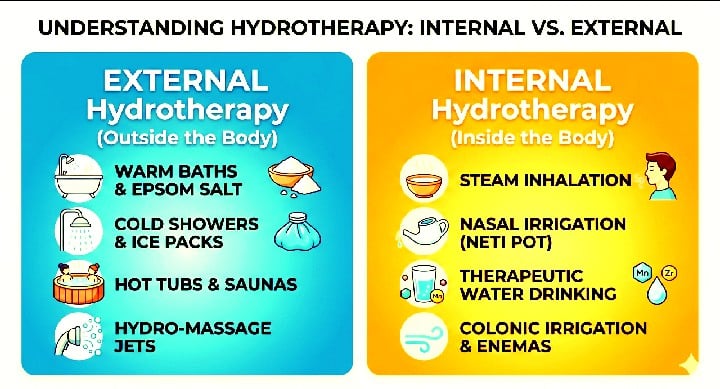
In my experience, external hydrotherapy works like magic for physical fatigue. If you look at the image above, you can see a tub equipped with jets. Those jets do not just feel good; they provide targeted pressure that breaks up tight knots in your back muscles.
Here are a few classic examples of external hydrotherapy that you can try this week:
Epsom Salt Baths:
You fill your tub with warm water and dump in two cups of magnesium-rich Epsom salts. The warm water dilates your blood vessels, while the magnesium relaxes your tired muscles.
Contrast Showers:
This technique will wake you up faster than a double shot of espresso. You stand under hot water for three minutes, then flip the knob to freezing cold for thirty seconds. You repeat this cycle three times.
Sitz Baths:
This is a shallow plastic basin that fits right over your toilet. You fill it with warm water to soothe irritation in your pelvic region. It works wonders for postpartum recovery or painful hemorrhoids.
Ice Packs and Cold Compresses:
When you sprain your ankle and immediately slap a bag of frozen peas on it, you are practicing external hydrotherapy. The cold numbs the pain and stops swelling in its tracks.
I want to share a quick story about contrast showers. A few months ago, I trained for a local 5K run. My legs felt like absolute lead after my long Saturday runs. I decided to try a contrast shower. The first time the cold water hit my back, I gasped and wanted to jump right out of the stall. But I stuck with it. I feel that those sudden temperature shifts forced my blood vessels to open and close rapidly, which pumped out the lactic acid built up in my calves. By Sunday morning, my legs felt fresh and ready to move again. I have observed that consistency with cold water really builds up your pain tolerance too.
The Inside Scoop on Internal Hydrotherapy
Now let's flip the coin and talk about internal hydrotherapy. This method involves bringing water inside your body to heal you from the inside out. People often forget that our internal organs respond beautifully to water therapy. We are not just talking about chugging eight glasses of tap water a day, though general hydration certainly matters. Internal hydrotherapy focuses on targeted treatments that clear out your airways, flush your digestive system, or hydrate your tissues deeply.
Take a look at the diagram above. This illustration shows a classic example of internal hydrotherapy: steam inhalation. When you inhale that hot moisture, the water vapor travels deep into your respiratory tract. It thins out thick mucus and calms down swollen nasal passages.
Let's look at the most common ways people use internal hydrotherapy today:
Steam Inhalation:
Just like the drawing shows, you lean over a bowl of boiling water with a towel draped over your head to trap the steam. You breathe deeply through your nose for ten minutes to clear out stubborn sinus congestion.
Neti Pots and Nasal Irrigation:
You pour a warm saline water mixture into one nostril and let it drain out the other. This physically washes away pollen, dust, and excess mucus from your sinus cavities.
Therapeutic Water Drinking:
This involves drinking specific amounts of mineral water at precise temperatures throughout the day to stimulate your stomach acid, improve digestion, or relieve chronic constipation.
Colonic Irrigation and Enemas:
A trained professional uses specialized equipment to gently flush your large intestine with warm water. This process removes waste buildup and hydrates your colon walls.
I used to suffer from terrible seasonal allergies every single spring. My nose would get so stuffed up that I could barely sleep at night. One evening, out of sheer desperation, I tried steam inhalation with a few drops of eucalyptus oil in the water. I sat there under my towel tent, sweating and breathing in the vapor. Within five minutes, my sinuses opened up completely. I could actually breathe through my nose again. It felt like a miracle. Since then, I always turn to internal steam therapy the second I feel a head cold coming on.
How Internal and External Hydrotherapy Work Together
You do not have to choose just one of these methods. In fact, they work best when you combine them. Think of external hydrotherapy as your go-to option for structural issues like sore muscles, joint pain, skin conditions, and stress. Think of internal hydrotherapy as your tool for systemic issues like sinus blockage, sluggish digestion, and deep cellular hydration.
You can easily build both habits into your regular weekly routine. For instance, you might start your morning with a contrast shower to shake off your grogginess and jumpstart your circulation. Then, later in the evening if you feel a bit congested from the outdoor air, you can spend ten minutes doing a simple steam inhalation session before bed.
Water is cheap, safe, and readily available right out of your tap. You do not need to overcomplicate things. Just listen to what your body needs. If your muscles ache, head for the bathtub. If your nose or stomach feels blocked up, focus on internal water methods. Your body knows how to heal itself; sometimes itngs moving in the right direction.
Contact
Reach us to book your wellness session
Email - rajnaturcure@gmail.com
© 2025. All rights reserved.