Note: Consult a doctor for health advice. Check out my favorite health products here: (Amazon Affiliate commission applies)
Natural Loofah Sponges vs. Plastic: Best Eco-Friendly Options
Discover the ultimate eco-friendly secret for your shower with the loofah plant. Learn how to switch from plastic to compostable bath products, keep your skin smooth, and contribute to cleaner oceans. Embrace a greener routine today!Natural Loofah Sponges vs. Plastic: Best Eco-Friendly Options
NATUROPATHY PRODUCT
Rajesh Kumar
5/2/20266 min read
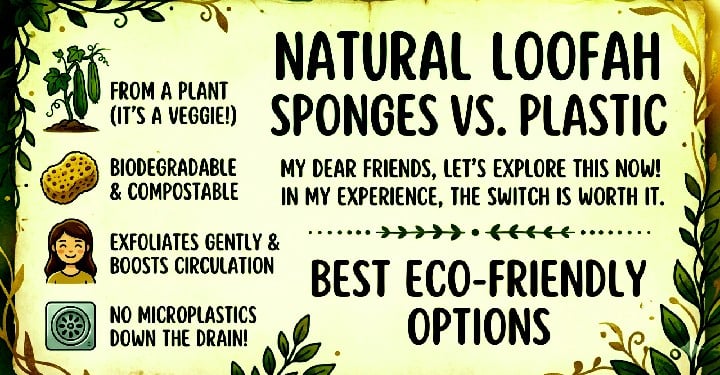
Hey there, my dear friends! I’m so glad you’re here because we need to have a serious heart-to-heart about something sitting in your shower right now. You know that colorful, puffy plastic mesh ball hanging from your shower head? We’ve all used them. They’re cheap, they lather up like crazy, and they come in every neon color under the sun. But as far as reality is concerned, those little plastic poufs are kind of a nightmare for the planet—and maybe even for your skin.
In my experience, making the switch to a natural lifestyle doesn't have to happen all at once. You don't need to sell your car and move into a yurt. Sometimes, it starts with the small stuff, like what you use to scrub your back on a Tuesday morning. I have observed that once people try a real, honest-to-goodness natural loofah, they rarely go back to the plastic stuff.
So, let’s explore this now. We’re going to look at why the natural loofah is the reigning champ of the bathroom and why it’s time to toss that plastic mesh into the bin for good. Without further ado, let’s proceed!
The Problem With Plastic Mesh Poufs
I remember back in college, I had this bright purple plastic loofah. I loved that thing. I thought it was the height of hygiene. But then I started noticing something gross. After a few weeks, it stayed damp, it started smelling a bit funky, and the little layers of plastic started to unravel.
Here is the kicker: those plastic sponges are made of synthetic materials like polyethylene. Every time you scrub your skin, tiny little bits of plastic—microplastics—wash down the drain. These bits are so small that water treatment plants can't always catch them. They end up in our rivers and oceans, and eventually, they find their way into the bellies of fish. It’s a mess.
Beyond the environment, plastic sponges are basically luxury hotels for bacteria. Because they have so many tight little folds and stay wet in a humid bathroom, they grow mold and germs faster than you can say "body wash." Scrubbing your body with a germ-filled plastic ball defeats the whole purpose of taking a shower, right?
What Exactly Is a Natural Loofah?
Most people I talk to think that loofahs come from the ocean. They think it's a sponge or a piece of coral. I used to think the same thing! But I was shocked to find out that a loofah is actually a vegetable.
Yes, you read that right. The *Luffa aegyptiaca* is a plant in the cucumber and gourd family. Imagine a giant, oversized zucchini growing on a vine. When the fruit matures and dries out, the fleshy part disappears, leaving behind a tough, fibrous skeleton. That fibrous "skeleton" is exactly what you’re using to scrub your skin.
I feel that there is something so cool about using a plant to get clean. It’s literally a gift from the earth. When you’re done with it, you can just toss it in your compost pile. It came from the ground, and it goes back to the ground. That is the definition of a "closed-loop" system, and it makes my eco-friendly heart very happy.
Why Natural Loofahs Are Better for Your Skin
I have observed that my skin feels completely different since I switched to the natural route. Plastic sponges are soft, sure, but they don't really exfoliate. They just move soap around. A natural loofah, however, has a bit of "grit" to it.
When you first get a natural loofah, it feels pretty hard and scratchy. Don’t let that scare you off! Once you soak it in warm water for a minute or two, it softens up beautifully. It provides the perfect level of exfoliation. It sloughs off dead skin cells, helps move your circulation along, and leaves your skin feeling incredibly smooth.
I used to get those annoying little bumps on the backs of my arms—you know, keratosis pilaris. I tried all kinds of expensive creams. But honestly? Using a natural loofah twice a week did more for those bumps than any $40 lotion ever did. It’s nature’s own dermabrasion tool.
Eco-Friendly Benefits You Can Feel Good About
Let's talk about the big picture. When we choose a natural loofah over a plastic one, we are voting with our wallets. We are telling big companies that we don't want more petroleum-based products in our homes.
Natural loofahs are biodegradable. This is a big deal. A plastic pouf will sit in a landfill for hundreds of years. It outlives you, your kids, and probably your grandkids. A natural loofah, on the other hand, breaks down in a few months. If you have a garden, you can literally bury it next to your tomatoes when it gets too old to use.
Also, many natural loofahs are grown by small-scale farmers. When you buy them, you’re often supporting sustainable agriculture rather than a massive chemical factory. In my experience, the quality is just better when it’s grown, not manufactured.
How to Care for Your Natural Loofah
I want to be real with you: natural loofahs do require a tiny bit more love than the plastic ones. Because they are organic material, you can't just leave them soaking wet in a corner and expect them to stay fresh.
Here is my routine for keeping mine in tip-top shape:
Rinse it well: After every shower, make sure you rinse out all the soap.
Dry it out: This is the most important part. Don't leave it in the shower where it stays misty. Hang it up somewhere with good airflow. I usually hang mine on a hook outside the shower curtain.
Deep clean once a week: I like to soak mine in a bowl of warm water with a little bit of baking soda or a drop of essential oil like tea tree or eucalyptus. This kills any lingering bacteria.
Replace it regularly: Even with great care, you should get a new one every 4 to 6 weeks. Since they are compostable, this isn't a "guilt trip" like it is with plastic!
Other Great Eco-Friendly Scrubbing Options
While I’m a huge fan of the loofah gourd, it’s not the only player in the game. If you find the loofah a bit too scratchy for your liking, there are other awesome ways to stay green in the shower.
Sea Sponges
These are actually animals (don't worry, they don't have nervous systems), and they are harvested from the ocean floor. They are incredibly soft and hold a ton of water. They feel like a cloud on your skin. Just make sure you buy "sustainably harvested" ones so we aren't hurting the coral reefs.
Sisal Poufs and Mitts
Sisal comes from the agave plant (the same plant that gives us tequila—thanks, agave!). It’s a very strong fiber. Usually, you’ll find sisal made into a little scrubby bag that you can slip a bar of soap into. It’s a great way to use up those tiny little soap scraps that usually get wasted.
Bamboo Brushes
If you prefer a handle so you can reach that one spot on your back that always itches, a bamboo brush is the way to go. Bamboo grows incredibly fast and doesn't need pesticides. It’s a much better alternative to plastic handles. Plus, a wooden brush just looks way classier sitting on your bathroom shelf.
Making the Switch Is Easier Than You Think
I know what you might be thinking. "Is it really worth the effort to change my sponge?"
I feel that we often overcomplicate "going green." We think we have to change everything at once. But I've found that these tiny changes are the ones that actually stick. When you replace your plastic sponge with a natural loofah, you aren't just helping the planet. You’re giving yourself a better shower experience. You’re taking care of your skin. You’re bringing a little piece of nature into your daily routine.
The next time you’re at the store or browsing online, skip the neon plastic aisle. Look for that weird, tan, dried-out veggie. Give it a soak, give it a scrub, and see how you feel. I bet you’ll feel a lot cleaner knowing you aren't washing microplastics down the drain.
My dear friends, we have the power to make our homes a little bit kinder to the Earth. It starts with one small choice. Let's choose the plant over the plastic. Your skin—and the ocean—will definitely thank you for it!
So, what do you think? Are you ready to ditch the plastic pouf for good? I'd love to hear about your favorite eco-friendly bathroom swaps. Until next time, stay sudsy and stay green!
Contact
Reach us to book your wellness session
Email - rajnaturcure@gmail.com
© 2025. All rights reserved.